Why does BHUMI do whatever it does? Why Education & the Environment?
It's a question lots of people have asked me... Why not clean the beach? Why not fight politics? Why not feed needy children? Why not fight corruption? The list is endless as are the ills that plague this country...
Obviously there are a lots of things a young group of individuals as large as ours can do to Make India a better place but why the focus only on Education and the Environment?
The answer is quite simple, 'We believe that these under-privileged children whom we work with are the latent potential India will need for the future and if we don't act against climate change there simply is no future for India or the human race'
Lastly one of my fav quotes... I think it explains a lot :)
"Never doubt that a small group of thoughtful, committed citizens can change the world. Indeed, it's the only thing that ever has." - Margret Mead
Cross Posted from The BHUMI, Chennai Blog
Thursday, September 11, 2008


Monday, September 1, 2008
BHUMI's Speak Out
“I am running late to work, AGAIN! And my 6 foot tall – stern faced – I can’t smile boss is not going to pardon me this time! Stuck in a traffic jam that is as long as a giraffe’s tongue. I see a mason’s daughter by the pavement making a beautiful sand castle. If only she could afford Education!! Sigh… Will the current situation ever change? Will
Oh, the signal just turned green. Now, vehicles are gonna crawl like ants! If only Batman’s utilities were applicable in the real world. Sci-fi has never impressed me, nevertheless…”
Such writing would make this blog usual!


Welcome to BHUMI!
From a small group of friends teaching at a school in 2006, BHUMI is now a guild of 250 students and young professionals. While educational projects target children of all ages, our environmental and societal initiatives focus on improving the current conditions of the local community.
Our volunteers hope to share their personal experiences and special BHUMI moments on this blog. Kicking off with how our English Teaching programme evolved.
Successful completion of KANINI (our e-literacy initiative) at Anbu Karangal and
Even though the children took time to open up, we bonded within weeks. During the course, I learnt that children here did not have answers to many questions: why am I at HOPE, why do I need to pop in capsules day and night, why do I feel drugged all day, how does it feel to be with ‘family’, and many more.
My outlook with respect to the World and its People changed. I realised how one’s hasty decision/action can change the life of another (unintentionally). Tears trickle down every time I think about the quality of life such boys and girls, in contrast to us, lead.
Unfortunately, their level of English was a barrier in proceeding further. That was when BHUMI started discussing the possibility of teaching our children English.
Make a Difference (MAD) an NGO based in
Now Bhumians are actively teaching at three orphanages and one community centre in Chennai. Trained by The Teacher Foundation (
If you want to be part of this initiative, visit us at www.bhumichennai.org and register!
Saturday, August 30, 2008
Project Kanini: Hidden Gems of PVR Orphanage
Though Speak Out classes have begun on time this year, Kanini's start was delayed due to the time taken to repair the computers donated to BHUMI by Satyam Computers.
Kanini's roll-out began this Independence Day weekend at Anbu Karangal and PV Rao Orphanage & School. After Ayyanar and his team gave a short introduction to computers, the 15 students of class 10 were allowed to work on the computers. All of them were 'touching' a computer for the first time in their life!

The Kanini Syllabus starts of with MS Paint, which allows the kids to learn mouse handling and also have some fun at the same time. The kids started working with a bit of help from the volunteers. Within 30 seconds one kid had drawn an India Map (more or less!) I don't know how many of you could have managed stuff like this within your first few minutes on a comp... I'm sure i would've struggled quite a bit.
As they gave finishing touches to their first drawings on a PC all of us were pleasantly surprised...

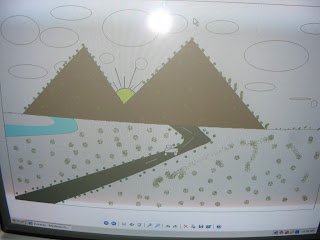
It left me thoughtful, What would've these children become with a normal family, childhood, education & facilities like a computer?
Another reminder that Children are a precious resource, they lack opportunity, not capability! Another wake up call for us as BHUMIans to work faster and better to bring more and more under-privileged children into our supplementary education programmes. The future is bright!

Cross Posted from the BHUMI, Chennai Blog
Kanini's roll-out began this Independence Day weekend at Anbu Karangal and PV Rao Orphanage & School. After Ayyanar and his team gave a short introduction to computers, the 15 students of class 10 were allowed to work on the computers. All of them were 'touching' a computer for the first time in their life!

The Kanini Syllabus starts of with MS Paint, which allows the kids to learn mouse handling and also have some fun at the same time. The kids started working with a bit of help from the volunteers. Within 30 seconds one kid had drawn an India Map (more or less!) I don't know how many of you could have managed stuff like this within your first few minutes on a comp... I'm sure i would've struggled quite a bit.
As they gave finishing touches to their first drawings on a PC all of us were pleasantly surprised...


It left me thoughtful, What would've these children become with a normal family, childhood, education & facilities like a computer?
Another reminder that Children are a precious resource, they lack opportunity, not capability! Another wake up call for us as BHUMIans to work faster and better to bring more and more under-privileged children into our supplementary education programmes. The future is bright!

Can u spot the Happy faces of the volunteers among the children? :)
Cross Posted from the BHUMI, Chennai Blog
Monday, August 4, 2008
Think Green
Climate change is the most agonizing challenge being faced by the humanity today. In a country of a billion population and a majority of them being dependent on the limited natural resources for the basic survival, the problem of climate change assumes a much greater significance. When the Himalayan glaciers, that feed almost 40% of the humanity (India and China), face the threat of a complete melt down due to increasing temperature, the agriculture that survives purely on the rivers fed by these glaciers would collapse resulting in the worst socio-economic crisis our country has ever faced. If the worst has to come, the perennial rivers could well become seasonal rivers, fed only by the monsoon, in the coming next three decades. With a 7000km long coastline, the threat of sea level rise poses a danger as grave as the melt down of glaciers. Severe shortage of food and drinking water, continuous failure of agriculture leading to collapse of a civil society is already being felt in some countries of the world. The need to address the issue of climate change is now at its highest point given the fact most of the extreme climatic events, like the break down of Larsen shelf, shrinking Greenland ice etc, are pre-dating the predictions of the scientific community. The only comforting point is that we might be just able to avert a crisis and stabilize the climate in its present form so that we may have just enough time to figure out ways to mitigate the problems and work towards a more sustainable earth. This is not all about climate change but a brief overview of the prospective dangers posed by climate change.
Every individual is a stakeholder in this process and the least anybody can do is to be aware – of the causes of the climate change, the individual’s contribution, ways of reducing the strain on environment and creating a more sustainable environment.
The Initiative:
Think Green is the initiative which is going to primarily focus on creating this awareness among the people of Chennai, to begin with and subsequently extending it to other parts of the state. The Program aims to produce a strong group of committed youth leaders who will carry the message of Climate Change, Leaders who will initiate and lead grassroots climate groups in their work, schools, colleges and communities. Alongside generating awareness, we envisage to take up a project in the form of a fieldwork to demonstrate that we aren’t just armchair philosophers but we would also engage in direct action to demonstrate our commitment for the cause.
The Program:
The time frame for the program is set at six months to one year and has three divisions.
1. Getting ourselves ready
2. Making presentations
3. Field Project
Getting ourselves ready: Most of us know about climate change but in order to make presentations that sound credible and convincing, it is important that we equip ourselves with authentic data and scientifically proven facts to back our claims. Enough material will be provided to the participants. The participants are expected to do some basic research into the subject and make a Power Point presentation. The culmination of this stage would be a one-day training session in which the participants would be provided with more perspectives and ideas that could be used to fine-tune their presentation. The training session will be held in roughly a month’s time.
People working for the same company or studying in the same college or even a group of individuals could team up to simplify the work and make the presentation more effective by doing independent in-depth research.
Making Presentations: Every group/individual is expected to make at least one presentation a month in schools/colleges/workplace/community or any other place of their choice. While Bhumi would actively look out for prospective places where presentations could be made participants are encouraged to identify places where they would be more comfortable.
Field Project: This is a relatively tricky assignment of the three. Nevertheless, this could be the most effective way to spread the message and drive the point home. The project could be anything from a tree plantation drive in the neighbouring community to campaigning against the usage of low grade plastic in residential colonies or sensitizing people in the office to reduce the consumption of fossil fuels by encouraging them to use public transport or forming car pools. Every group or participant is expected to submit a draft proposal one the eve of the training session.
People who want be a part of this program please fill this form. All fields are mandatory to have a rough idea and generate a pool of ideas to proceed with.
http://spreadsheets.google.com/viewform?key=pr8utZ7S3Ncsh4tddddsALw&email=true
Every individual is a stakeholder in this process and the least anybody can do is to be aware – of the causes of the climate change, the individual’s contribution, ways of reducing the strain on environment and creating a more sustainable environment.
The Initiative:
Think Green is the initiative which is going to primarily focus on creating this awareness among the people of Chennai, to begin with and subsequently extending it to other parts of the state. The Program aims to produce a strong group of committed youth leaders who will carry the message of Climate Change, Leaders who will initiate and lead grassroots climate groups in their work, schools, colleges and communities. Alongside generating awareness, we envisage to take up a project in the form of a fieldwork to demonstrate that we aren’t just armchair philosophers but we would also engage in direct action to demonstrate our commitment for the cause.
The Program:
The time frame for the program is set at six months to one year and has three divisions.
1. Getting ourselves ready
2. Making presentations
3. Field Project
Getting ourselves ready: Most of us know about climate change but in order to make presentations that sound credible and convincing, it is important that we equip ourselves with authentic data and scientifically proven facts to back our claims. Enough material will be provided to the participants. The participants are expected to do some basic research into the subject and make a Power Point presentation. The culmination of this stage would be a one-day training session in which the participants would be provided with more perspectives and ideas that could be used to fine-tune their presentation. The training session will be held in roughly a month’s time.
People working for the same company or studying in the same college or even a group of individuals could team up to simplify the work and make the presentation more effective by doing independent in-depth research.
Making Presentations: Every group/individual is expected to make at least one presentation a month in schools/colleges/workplace/community or any other place of their choice. While Bhumi would actively look out for prospective places where presentations could be made participants are encouraged to identify places where they would be more comfortable.
Field Project: This is a relatively tricky assignment of the three. Nevertheless, this could be the most effective way to spread the message and drive the point home. The project could be anything from a tree plantation drive in the neighbouring community to campaigning against the usage of low grade plastic in residential colonies or sensitizing people in the office to reduce the consumption of fossil fuels by encouraging them to use public transport or forming car pools. Every group or participant is expected to submit a draft proposal one the eve of the training session.
People who want be a part of this program please fill this form. All fields are mandatory to have a rough idea and generate a pool of ideas to proceed with.
http://spreadsheets.google.com/viewform?key=pr8utZ7S3Ncsh4tddddsALw&email=true
Sunday, August 12, 2007
The Tricolour National Flag
On August 15, 1947: The tricolour National Flag was first flown above the Red Fort, Delhi, signifying the transfer of power from Britain to India.

The National Flag shall be a tri-colour panel made up of three rectangular panels or sub-panels of equal widths. The colour of the top panel shall be India saffron (Kesari) and that of the bottom panel shall be India green. The middle panel shall be white, bearing at its centre the design of Ashoka Chakra in navy blue colour with 24 equally spaced spokes. The Ashoka Chakra shall preferably be screen printed or otherwise printed or stenciled or suitably embroidered and shall be completely visible on both sides of the Flag in the centre of the white panel.
The significance of the colours and the chakra in the National Flag was amply described by Dr. S. Radhakrishnan in the Constituent Assembly, which unanimously adopted the National Flag. Dr. S. Radhakrishnan explained—“Bhagwa or the saffron colour denotes renunciation of disinterestedness. Our leaders must be indifferent to material gains and dedicate themselves to their work. The white in the centre is light, the path of truth to guide our conduct. The green shows our relation to soil, our relation to the plant life here on which all other life depends. The Ashoka Wheel in the center of the white is the wheel of the law of dharma. Truth or satya, dharma or virtue ought to be the controlling principles of those who work under this flag. Again, the wheel denotes motion. There is death in stagnation. There is life in movement. India should no more resist change, it must move and go forward. The wheel represents the dynamism of a peaceful change.”

The National Flag shall be a tri-colour panel made up of three rectangular panels or sub-panels of equal widths. The colour of the top panel shall be India saffron (Kesari) and that of the bottom panel shall be India green. The middle panel shall be white, bearing at its centre the design of Ashoka Chakra in navy blue colour with 24 equally spaced spokes. The Ashoka Chakra shall preferably be screen printed or otherwise printed or stenciled or suitably embroidered and shall be completely visible on both sides of the Flag in the centre of the white panel.
The significance of the colours and the chakra in the National Flag was amply described by Dr. S. Radhakrishnan in the Constituent Assembly, which unanimously adopted the National Flag. Dr. S. Radhakrishnan explained—“Bhagwa or the saffron colour denotes renunciation of disinterestedness. Our leaders must be indifferent to material gains and dedicate themselves to their work. The white in the centre is light, the path of truth to guide our conduct. The green shows our relation to soil, our relation to the plant life here on which all other life depends. The Ashoka Wheel in the center of the white is the wheel of the law of dharma. Truth or satya, dharma or virtue ought to be the controlling principles of those who work under this flag. Again, the wheel denotes motion. There is death in stagnation. There is life in movement. India should no more resist change, it must move and go forward. The wheel represents the dynamism of a peaceful change.”
A call to the Nation on the eve of our 60th Independence Day
Every year in the life of every Indian come these special days – the 15th of August and the 26th of January. Two more holidays…!. Or is it something more than that??
On one side we have the school children ― who are forced to wakeup much earlier than usual on these days and attend the flag hoisting, and on the other side we have people who probably have never seen any tricolour being hoisted since ages – because by the time they wake up these holidays all the flags are already hoisted. This is the same set of people who state that “Vande Maataram” should be our national anthem and not “Jana Gana Mana”, but haven’t sung either of them since ages.
Lost among these masses are a few awakened souls who atleast for a moment feel concerned and worried that “Everything is not fine with our motherland”. In these 60 years of Independence we have certainly not reached where we had set out for. On the contrary we are headed towards where we should not be going. Sad is the fact that most such concerns end up with either complaining about lack of ethical and moral values among we Indians comparing ourselves to the westerners or else blaming the Politicians of the country for being corrupt and malevolent and holding them responsible for the state of affairs in India and finally concluding “Nothing can be done”.
Bharat Uday Mission believes India can be set back on the right track. What is required is the good will and faith of the awakened masses led and guided by the sacrifices of the enlightened few. Most Indians dream of seeing India become the superpower of the 21st century, a golden sparrow of the world. Bharat Uday Mission is committed to give a divine hope to every such soul. We are dedicated to bringing India to the zenith of its glory – “Whatever it takes”.
This Independence day dedicated to all those concerns, worries and wishes of the common Indian man- Bharat Uday Mission comes up with a noble cause of avoiding the dishonor rendered to the Tiranga by we ignorant citizens. We call upon every citizen to stand up for the cause and try to avoid any such dishonor by him or in his presence.
Gone are the days when we as children used to sit down with crayons and a scissor and craft our own Tricolour and wave it with pride. Now-a-days it’s just the matter of a rupee – that’s all the flag made up of polythene costs. All we need is to pay a penny and wave it or even post it on our vehicles. We wave it until we get bored, or it remains hoisted on the vehicles as long as it can stand there – and then we will find it fallen on the road side forming part of the garbage.
How many of us even know that manufacture and use of poorly made cheap plastic flags is against the flag code of India. More so we are not supposed to use the flag for hoisting on the public vehicles. Ok fine we may object that how can we be questioned against expressing our love and pride for the Motherland and our very own national flag. But the insulting thing is where that love and pride disappears by the end of the day or the next day when the same flags are lying on the roadside with the garbage and even in the drains… Now, this certainly is a very reprehensible issue. In fact the flag code clearly states that ‘after use, the flags have to be disposed off properly with full honour’. Proper disposal is the responsibility of every citizen and a matter of respect to the nation to be adhered by every one of us.
So this Independence Day Bharat Uday Mission is on the mission of preventing dishonor of any form being rendered to the national flag in the city/country. This act comes as a measure of justifying the fact that a small team of enlightened individuals backed by the goodwill support and participation of the awakened masses can bring about a noticeable change in the city... And more so in the country too.
On one side we have the school children ― who are forced to wakeup much earlier than usual on these days and attend the flag hoisting, and on the other side we have people who probably have never seen any tricolour being hoisted since ages – because by the time they wake up these holidays all the flags are already hoisted. This is the same set of people who state that “Vande Maataram” should be our national anthem and not “Jana Gana Mana”, but haven’t sung either of them since ages.
Lost among these masses are a few awakened souls who atleast for a moment feel concerned and worried that “Everything is not fine with our motherland”. In these 60 years of Independence we have certainly not reached where we had set out for. On the contrary we are headed towards where we should not be going. Sad is the fact that most such concerns end up with either complaining about lack of ethical and moral values among we Indians comparing ourselves to the westerners or else blaming the Politicians of the country for being corrupt and malevolent and holding them responsible for the state of affairs in India and finally concluding “Nothing can be done”.
Bharat Uday Mission believes India can be set back on the right track. What is required is the good will and faith of the awakened masses led and guided by the sacrifices of the enlightened few. Most Indians dream of seeing India become the superpower of the 21st century, a golden sparrow of the world. Bharat Uday Mission is committed to give a divine hope to every such soul. We are dedicated to bringing India to the zenith of its glory – “Whatever it takes”.
This Independence day dedicated to all those concerns, worries and wishes of the common Indian man- Bharat Uday Mission comes up with a noble cause of avoiding the dishonor rendered to the Tiranga by we ignorant citizens. We call upon every citizen to stand up for the cause and try to avoid any such dishonor by him or in his presence.
Gone are the days when we as children used to sit down with crayons and a scissor and craft our own Tricolour and wave it with pride. Now-a-days it’s just the matter of a rupee – that’s all the flag made up of polythene costs. All we need is to pay a penny and wave it or even post it on our vehicles. We wave it until we get bored, or it remains hoisted on the vehicles as long as it can stand there – and then we will find it fallen on the road side forming part of the garbage.
How many of us even know that manufacture and use of poorly made cheap plastic flags is against the flag code of India. More so we are not supposed to use the flag for hoisting on the public vehicles. Ok fine we may object that how can we be questioned against expressing our love and pride for the Motherland and our very own national flag. But the insulting thing is where that love and pride disappears by the end of the day or the next day when the same flags are lying on the roadside with the garbage and even in the drains… Now, this certainly is a very reprehensible issue. In fact the flag code clearly states that ‘after use, the flags have to be disposed off properly with full honour’. Proper disposal is the responsibility of every citizen and a matter of respect to the nation to be adhered by every one of us.
So this Independence Day Bharat Uday Mission is on the mission of preventing dishonor of any form being rendered to the national flag in the city/country. This act comes as a measure of justifying the fact that a small team of enlightened individuals backed by the goodwill support and participation of the awakened masses can bring about a noticeable change in the city... And more so in the country too.
Flag Code and How it is being Violated in Public
It is a well-known fact that the Tricolour is treated too casually by many in the public. The National flags are seen lying on the roadside along with the other garbage and even in drains by the evening of the Independence Day, the Republic Day and other National Days. Cheap plastic flags, rather than the sacred Khadi Flags have become the order of the day. Such a treatment is not only a violation of the ‘Flag Code’ and other applicable laws like the ‘Emblems and Names Act, 1950’, ‘Prevention of Insults to National Honour Act, 1971’, but also an atrocity on the patriotic sentiment of every true citizen of India.
Flag Code and How it is being Violated in Public
There are strict standards to be adhered to for making and using the flag. The Hubli-based Karnataka Khadi Gramodyoga Samyukta Sangha (KKGSS) has been certified as the sole institution to supply national flags for the entire country, by the Khadi and Village Industries Commission (KVIC) in conformation with the standards laid down by the Bureau of Indian Standards (BIS). Few Indians even know there is one. Some important stipulations laid down in the Flag code are as follows:
· First, there are nine standard sizes to which our flag is made, each with a special purpose for which only it may be used.
· The colors have to be of the exact shade specified by KVIC and BIS. Both saffron and green have to be of equal length and breadth.
· The length and width of the entire flag should be in the ratio 2:3.
· The chakra should contain 24 equally spaced spokes. The chakra should be printed on both sides; the position of both synchronized.
· There should be a four-thread stitch in each centimeter of the cloth. The flag edge (for rod insertion) has stipulated dimensions.
· Only, hand-spun and hand-woven cloth can be used for a national flag.
· Only cotton, silk, wool or khadi can be used.
· Whenever it is flown, it should occupy the position of honour and be distinctly placed.
· The flag must not be used as a festoon, rosette or bunting or in any other manner of decoration. It should not be used as a portion of a costume or uniform. It should not also be embroidered on any cushion, handkerchief, or printed on napkins or boxes.
· Only specified Indian dignitaries can fly the flag atop their cars.
· Even the half-masting during mourning has to be done only for certain dignitaries' deaths. This too in a certain procedure ― it has to be hoisted briskly, and lowered slowly.
Any defects in the manufacture of flags, such as colour, size and thread count are considered a serious offence and are liable for fine or imprisonment or both, as per the provisions of Flag Code of India. The flags will have to be first quality-checked by the BIS. If they find any defect, the entire lot will be rejected. Even the tailors need certain specified diplomas / training certificates to be recruited.
"Flying a plastic or paper flag can attract imprisonment of up to three years with a fine. Even for disposing of a damaged or discolored national flag (the Flag Code says these are not to be used), you have to gather a/few local leader(s), and in their presence, burn it and then bury it. Also, private citizens can only hoist it in their homes, not cars,"
The Indian Navy uses woolen Flags, the Army cotton and silk ones, and the Air Force mostly silk. The Flag Code of India says there are nine different sizes in which the flag is made. Each has certain dimensions and a specified use. The sizes range from a few inches to a few feet. The smallest one (Size Nine) ― 6 inches X 4 inches or 150 mm X 100 mm is for use as a table flag during meetings, conferences involving participation by foreign countries (you would have seen this one in countless TV clippings and newspaper photos); Size Eight – 9 inches X 6 inches or 225 mm X 150 mm is for use in VVIP cars; Size Seven ― 18 inches X 12 inches or 450 mm X 300 mm for VVIP aircraft and train carrying the President; Size Six – 3 ft X 2 ft or 900 mm X 600 mm for display in rooms on cross bar, etc.; on deceased persons; Size Five ― 5.5 ft X 3 ft or 1,350 mm X 900 mm) for smaller sized public buildings; Size Four – 6 ft X 4 ft or 1,800 mm X 1,200 mm on deceased persons entitled to state / military funerals and on small government buildings. Size Three – 9 ft X 6 ft or 2,700 mm X 1,800 mm on Parliament House and medium sized government buildings; Size Two -- 12 ft X 8 ft or 3,600 mm X 2,400 mm on gun carriages, Red Fort, Rashtrapati Bhavan; Size One -- the biggest of them all (21ft into 14ft or 6,300 mm into 4,200 mm) is for very large buildings with a high flag mast.
Flag Code and How it is being Violated in Public
There are strict standards to be adhered to for making and using the flag. The Hubli-based Karnataka Khadi Gramodyoga Samyukta Sangha (KKGSS) has been certified as the sole institution to supply national flags for the entire country, by the Khadi and Village Industries Commission (KVIC) in conformation with the standards laid down by the Bureau of Indian Standards (BIS). Few Indians even know there is one. Some important stipulations laid down in the Flag code are as follows:
· First, there are nine standard sizes to which our flag is made, each with a special purpose for which only it may be used.
· The colors have to be of the exact shade specified by KVIC and BIS. Both saffron and green have to be of equal length and breadth.
· The length and width of the entire flag should be in the ratio 2:3.
· The chakra should contain 24 equally spaced spokes. The chakra should be printed on both sides; the position of both synchronized.
· There should be a four-thread stitch in each centimeter of the cloth. The flag edge (for rod insertion) has stipulated dimensions.
· Only, hand-spun and hand-woven cloth can be used for a national flag.
· Only cotton, silk, wool or khadi can be used.
· Whenever it is flown, it should occupy the position of honour and be distinctly placed.
· The flag must not be used as a festoon, rosette or bunting or in any other manner of decoration. It should not be used as a portion of a costume or uniform. It should not also be embroidered on any cushion, handkerchief, or printed on napkins or boxes.
· Only specified Indian dignitaries can fly the flag atop their cars.
· Even the half-masting during mourning has to be done only for certain dignitaries' deaths. This too in a certain procedure ― it has to be hoisted briskly, and lowered slowly.
Any defects in the manufacture of flags, such as colour, size and thread count are considered a serious offence and are liable for fine or imprisonment or both, as per the provisions of Flag Code of India. The flags will have to be first quality-checked by the BIS. If they find any defect, the entire lot will be rejected. Even the tailors need certain specified diplomas / training certificates to be recruited.
"Flying a plastic or paper flag can attract imprisonment of up to three years with a fine. Even for disposing of a damaged or discolored national flag (the Flag Code says these are not to be used), you have to gather a/few local leader(s), and in their presence, burn it and then bury it. Also, private citizens can only hoist it in their homes, not cars,"
The Indian Navy uses woolen Flags, the Army cotton and silk ones, and the Air Force mostly silk. The Flag Code of India says there are nine different sizes in which the flag is made. Each has certain dimensions and a specified use. The sizes range from a few inches to a few feet. The smallest one (Size Nine) ― 6 inches X 4 inches or 150 mm X 100 mm is for use as a table flag during meetings, conferences involving participation by foreign countries (you would have seen this one in countless TV clippings and newspaper photos); Size Eight – 9 inches X 6 inches or 225 mm X 150 mm is for use in VVIP cars; Size Seven ― 18 inches X 12 inches or 450 mm X 300 mm for VVIP aircraft and train carrying the President; Size Six – 3 ft X 2 ft or 900 mm X 600 mm for display in rooms on cross bar, etc.; on deceased persons; Size Five ― 5.5 ft X 3 ft or 1,350 mm X 900 mm) for smaller sized public buildings; Size Four – 6 ft X 4 ft or 1,800 mm X 1,200 mm on deceased persons entitled to state / military funerals and on small government buildings. Size Three – 9 ft X 6 ft or 2,700 mm X 1,800 mm on Parliament House and medium sized government buildings; Size Two -- 12 ft X 8 ft or 3,600 mm X 2,400 mm on gun carriages, Red Fort, Rashtrapati Bhavan; Size One -- the biggest of them all (21ft into 14ft or 6,300 mm into 4,200 mm) is for very large buildings with a high flag mast.
Subscribe to:
Posts (Atom)

 Posts
Posts


